

Esé Emmanuel
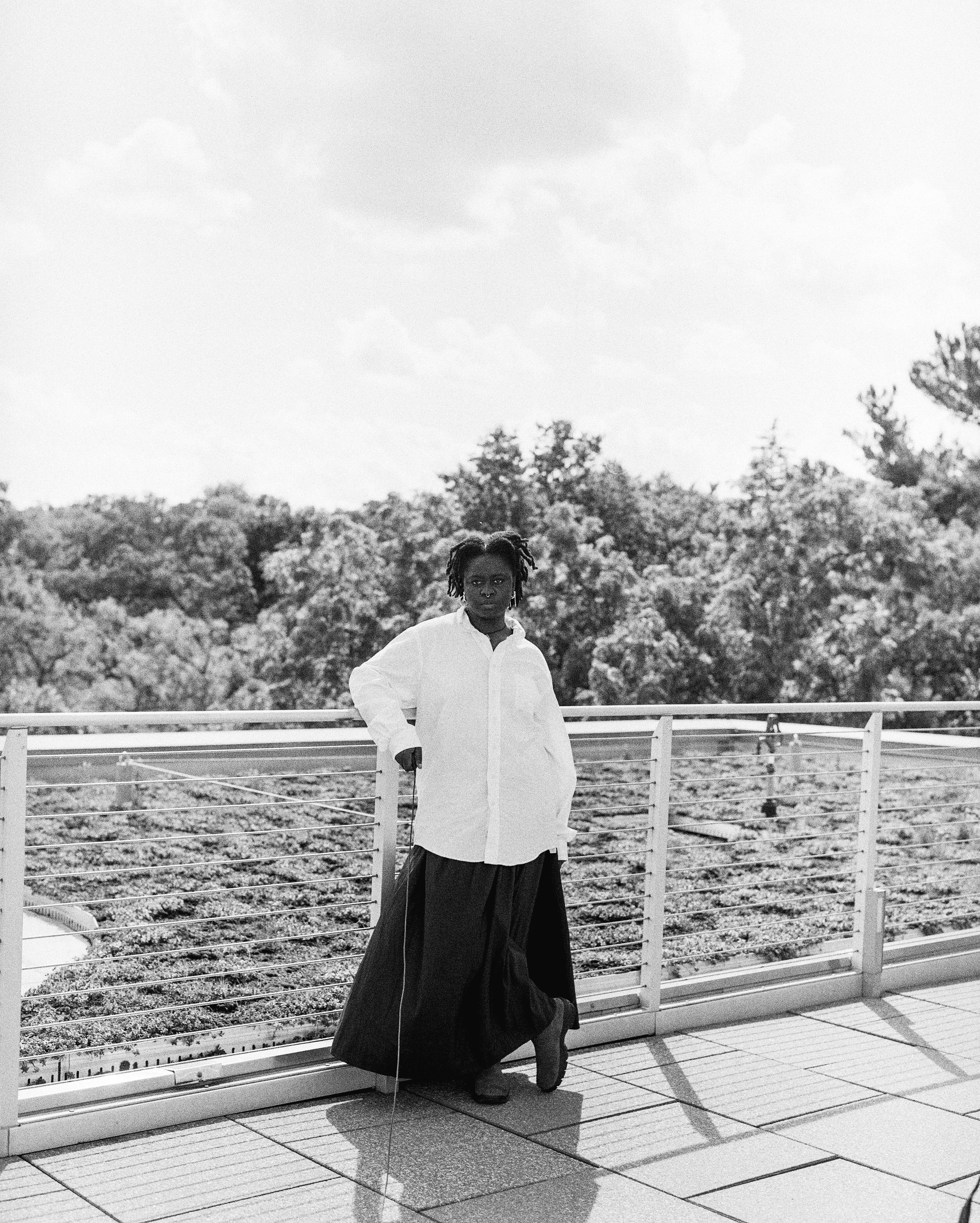
Esé on Rooftop of VAB, collaborative portrait.
Esé, wearing a button down white shirt, a long black skirt, and boots stands against a railing on the roof of the Visual Arts Building. They look directly at the camera and hold a cable release in their right hand. In the background is a tree line and an open sky.
ARTIST STATEMENT: ONE LONG ARC OF MORNING (x)
I have been increasingly interested in the distinctions between the interior and the exterior. Even more so, I am fascinated by the moments in which these distinctions collapse, unable to sustain themselves. Encountering the outside from the inside (or vice versa) is one such moment, and this is what the unnamed character enacts in One Long Arc of Morning (x). Similarly, the camera is an equipment specifically constructed to materialize the experience of containing the exterior—spatially within its lens, and temporally within a still or moving image. In this, it is not unique, considering that it mimics the eye.
These organs and technologies maintain their basis on capture and containment, but I am compelled by the moments of failure, the puncturing of the enclosure. A film, for example, generally purports to hold images or sounds or other such signs within itself, independently or in tandem. And there is an upheld fiction that a good [film, photograph, etc.] is one in which these elements exist in observable, if not perfect, containment; when they cohere; when they do not overwhelm their seams. But what happens when they do? What might one make of the more troublesome fragments?
BIO:
Esé Emmanuel is a writer, artist, and curator attentive to the forms of things and the ways they escape formation. They think across architectures, black poetics, third cinema, and other visual, textual and material cultures.
ALTERNATIVE TEXT: ONE LONG ARC OF MORNING (x)
One Long Arc of Morning (x) is a four-minute long film rendered in black and white. It is composed of still images which fade in and out of the screen whole or in fragments. There are long stretches in which there are no images on the screen at all, only blackness. The following are short descriptions of the photographs and silent text observed in the film:
A title card reads, “One Long Arc of Morning (x)”
A photograph of the light and shadows that form around the curved fabric of a sheer curtain is split into four quadrants. The image is never encountered whole. One vaguely makes out the outline of a door behind the curtain, the shadow of a plant, and a drawstring, presumably of blinds which remain out of sight.
A photograph is split into two, on the vertical plane. The image is never encountered whole. One half of the image reveals rectangular strips of light, emerging from a shadowy wall. The other half reveals a glass window. A house, car and trees can be observed from outside.
A photograph is split into two, on the horizontal plane. The image is never encountered whole. Both halves reveal a desk by the window. There is a board with some illegible text, and some markers on this desk. In the background, nearly overtaken by shadow, one finds the edge of a bed, and a rug.
A photograph is encountered whole, except that an entire half of this photograph is left unexposed and submerged in blackness. The visible half, to the right, shows a window, a chair, and a table with some books on it. From behind the window appear large blocks of bright light, which reveal exterior buildings and automobiles.
A photograph is split into four quadrants. The image is never encountered whole. Pieced together, they reveal a lamp, a circular window, the top edge of a spiral staircase. A doorway and a door knob.
A photograph is split into two, on the vertical plane. The image is never encountered whole. One half is entirely a lightly curved rectangular band of white light, presumably from a sheer curtain. The other half shows a mirror with a thin strip of light within it. On the wall adjacent to the mirror are numerous other light strips, collecting to form the vague shape of a window.
A photograph is split in two, on the horizontal plane. The image is never encountered whole. Pieced together, they reveal a mirror on the wall, which reflects within it, the shape of a window. Superimposed over the mirror and the wall are shadows of window blinds and the bent figure of a human.
A photograph of a bed is encountered whole. It is not made, and on its surface can be found rumpled sheets, a bunched up comforter, and some pillows.
A window-side photograph is encountered whole. A fan, some flowers, sheets of paper, heaps of clothes and other miscellaneous objects are set in deep shadow, contrasting with the bright light that streams inside from the window.
The closing credits read: “Contributors: Pensée I., Yaw A., s.j.a., Theo S.” A short distance away from the previous names is “Esé Emmanuel”.